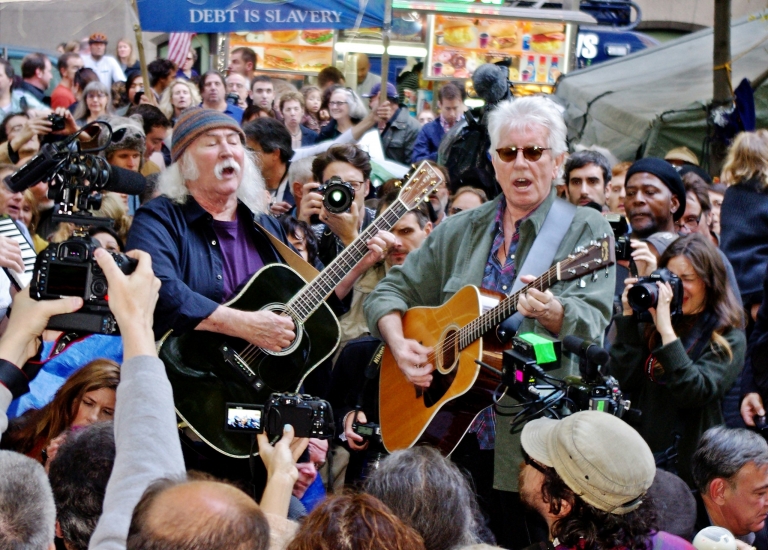
Rarely has the hippie movement been embodied as strikingly as by Crosby, Stills, Nash & Young, one of the first supergroups in pop history. The quartet represented, in terms of music, image, lifestyle, and political beliefs, a generation of progressive young people who sought social renewal and a life of freedom. Their song 'Teach Your Children' became the anthem for young contemporaries all pursuing the same ideals.
The members were David Crosby, Stephen Stills, and Graham Nash, and when flanked by Neil Young, the group was called Crosby, Stills, Nash & Young (CSNY). The band formed at the end of the 1960s and was known for the complex vocal harmonies of its members, their tumultuous relationships, and their political activism. For many, they personified the hippie culture. Well-known songs include Teach Your Children, Ohio, and Our House. Before the CSN members met and formed the group, they each played in other prominent bands. David Crosby was guitarist with The Byrds; Stephen Stills was guitarist, keyboardist, singer, and songwriter with Buffalo Springfield (which also included Neil Young); and Graham Nash played guitar, sang, and wrote songs with The Hollies.
Their first success came in 1969 with the album Crosby, Stills & Nash, followed by a tour. Later that year, as CSNY, they made their debut at the Woodstock festival and released the album Déjà Vu as a quartet. In 1970, the group split due to alcohol and drug problems, and the members went their separate ways. This separation lasted four years; then they embarked on a successful tour of the US and England. After that tour, internal problems took their toll again, and the musicians continued as duos or solo artists, later reuniting as a trio or quartet. This cycle repeated several times, with the last joint performance of CSNY in 2013 and of CSN in 2015. In 2016, Nash announced in interviews that the group was definitively finished. Crosby, Stills & Nash won a Grammy Award in 1969, and all four were twice inducted into the Rock and Roll Hall of Fame.
The young hippies of yesteryear have now become well into their seventies, who despite their wealth still stand for the ideals of the past that they continue to cherish. “We often did things that musicians were not supposed to do. I think we were willing to put our musical lives and our physical lives on the line for things that we felt very strongly about. Maybe we may have moved the world a millimetre or two,” said Graham Nash.
Top 2000
Crosby, Stills, Nash & Young appear as a quartet with 3 records in the 23rd edition of the Top 2000:
Sunday Morning Classic: DéjàVu
On 21 February 2021, the men were guests on our "stage" as Sunday Morning Classic with their favourite album DéjàVu.
As one of the long-awaited second albums in history, DéjàVu lived up to expectations and rose to number one in the charts.
DéjàVu worked as an album, a product of four powerful musical talents all at the top of their game, combined with very skilled production, engineering, and editing. There were also some clear virtues: the addition of Neil Young to the Crosby, Stills & Nash line-up contributed to the level of virtuosity, with Young and Stephen Stills reaching new levels of complexity and volume on their guitars. Young's presence also increased the number of available voices and added a unique, quirky songwriter to the group, although most of Young's contributions in this regard were limited to the second side of the LP. Most of the music, apart from the quartet version of Joni Mitchell's "Woodstock," was done as individual sessions by each member when they showed up (which was rarely together), contributing what was needed and agreed upon. "Carry On" worked as the album opener when Stills 'sacrificed' another copyright, "Questions," which made up the second half of the song and made it more substantial. "Woodstock" and "Carry On" represented the group as a whole, while the rest of the record was a showcase for the individual members.
David Crosby's "Almost Cut My Hair" was a piece of energetic paranoia from the hippie era. "Teach Your Children," the album's big hit, reflected the idealism of the hippie era that still filled Graham Nash's life, while "Our House" was his stylistic tribute to the late Beatles and "4+20"... And then there were Neil Young's pieces, the exquisitely harmonised "Helpless" and the roaring country-like rockers that ended side two, where Young had a lot of input, including his apparent throwaway finale, "Everybody I Love You." All this variety made DéjàVu a rich musical banquet for the most serious and personal listeners, while the general public enjoyed the glorious harmonies and thunderous electric guitars, which were presented in an even more dramatic and extensive way during the subsequent tour.
Source: Jan Liebregts, NPO and Wikipedia Photo: By CMA-Creative Management Associates/Atlantic Records and David Shankbone