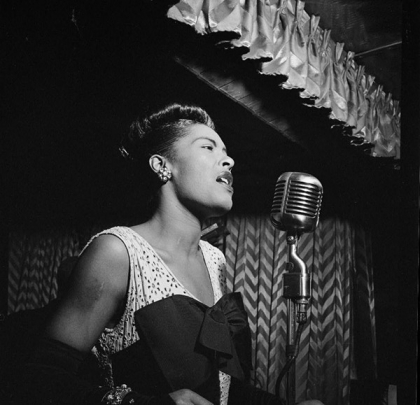
Billie Holiday was born on 7 April 1915 in Baltimore as Eleanora Fagan Gough. Her father was a jazz musician and left the family when Billie was still a baby. Billie’s mother was only 13 years old then. Her mother struggled to care for her daughter and often left her with relatives who proved untrustworthy. As a young girl Billie worked as a cleaner and heard music by Louis Armstrong and Bessie Smith. When Billie was about ten she was raped and was forced to attend a Catholic reform school. After two years she left there and moved with her mother to New Jersey. After living there for a while they moved to Brooklyn, New York. Here Billie turned to prostitution to earn extra money.
According to her own biography she was discovered in 1933, when a dance audition failed, and she was instead asked to sing, but it seems more likely that she was already singing in New York jazz clubs in 1930 or 1931. What is certain is that in 1933 she first came into the public eye through a column in Melody Maker, written by producer John Hammond. He introduced her to Benny Goodman, who gave her a record debut with her own band with the song Your Mother's Son in Law.
The following year Holiday made a splash in New York jazz clubs, resulting in a performance at the renowned Apollo Theater. Later she played with Lester Young, Count Basie and Artie Shaw. She broke racial segregation by playing with white musicians.
Holiday worked for Columbia at the end of the 1930s when she became acquainted with a song called Strange Fruit, about the lynching of a black man. It was written by Bronx-born high school teacher, writer, poet and songwriter Abel Meeropol who wrote the song in 1937 under the pseudonym "Lewis Allen". Meeropol, a communist of Russian-Jewish descent, was deeply shocked by and strongly opposed to the racial madness in America. Over her life Holiday increasingly used alcohol and drugs. In 1947 she was even arrested for violating drug laws, after which she spent a year in a rehabilitation centre. Although she no longer had a permit to perform in New York, Holiday continued to give concerts. Ten days after her release she sang in a packed concert hall at Carnegie Hall. Her ongoing heroin addiction did affect her voice, but not her sensitivity and technique. Ultimately this addiction cost her her life in 1959.
Three years before her death she wrote, with the help of journalist William Dufty, her autobiography: Lady Sings the Blues (also the title of one of her biggest hits). The story is controversial, as she is said to have taken liberties with the facts. The book tells a harrowing story about drug use, government-imposed detox treatments and relationships with men who almost without exception exploited and abused her. Lady Sings the Blues was filmed in 1972 with Diana Ross as Billie Holiday.
Sunday Morning Classic: Lady Sings The Blues
On 13 September 2020 Billie was our guest as Sunday Morning Classic.
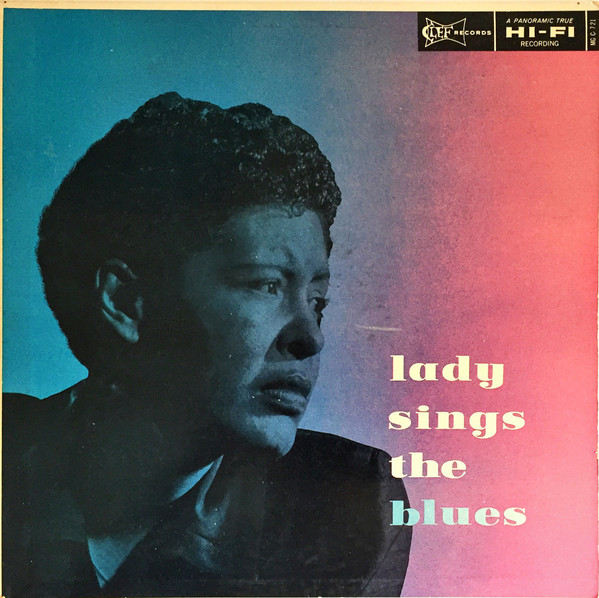
Writer Nat Hentoff said about Billie Holiday: "The experience of listening to her cannot be analysed - you either feel it or you don’t." And this Lady Sings The Blues is living proof of that. Recorded during two separate sessions in Los Angeles in September 1954 and across two days in June 1956 in New York City, this is an album that comes as close as possible to a musical autobiography.
The sessions in Los Angeles offer a fresher sounding Billie, but that does not detract from the quality of the tracks recorded in New York City. When it was originally released on Clef records it received a favourable review and 5 stars. In a review of the 78 rpm release of 'Love Me Or Leave Me' combined with 'I Thought About You', it was said: "What counts is the intense personal presence of Lady Day." That says it all.
The Los Angeles sessions at Capitol Studios feature Harry Edison (trumpet), Willie Smith (alto saxophone), Bobby Tucker (piano), Barney Kessel (guitar), Red Callender (bass) and Chico Hamilton (drums) and they create a musical bed over which Billie drapes herself. For the later sessions in New York at Fine Sound Studios there is a complete change of musicians with the brilliant Wynton Kelly on piano along with Charlie Shavers (trumpet), Tony Scott (clarinet, arranger), Paul Quinichette (tenor saxophone), Kenny Burrell (guitar), Aaron Bell (bass) and Lenny McBrowne (drums).
When Lady Sings The Blues was released, there was a concert on 10 November 1956 at Carnegie Hall in New York City featuring much of this material along with readings from her autobiography, which had the same name as the album. It was sold out and despite the limitations of Billie's voice she gave a great performance - less than three years later she would be dead. Age 44 years.
Billie Holiday, as everyone now knows, led a troubled life - all of this is candidly revealed in her autobiography. But it is a fact that the printed word can only explore a limited number of subtleties of the human experience. For the rest – well, when Lady sings the blues on vinyl, she sings with everything she has.
Source: Jan Liebregts and Wikipedia