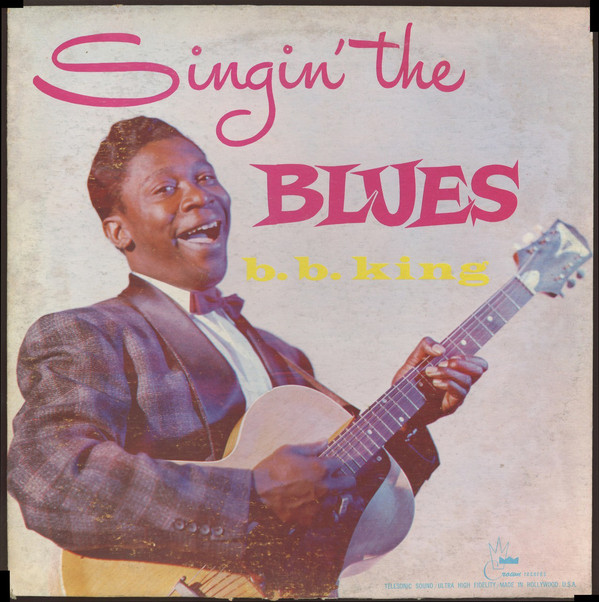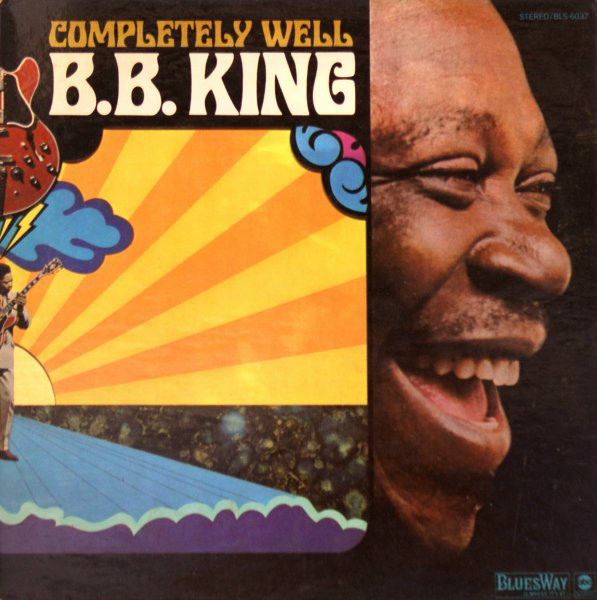
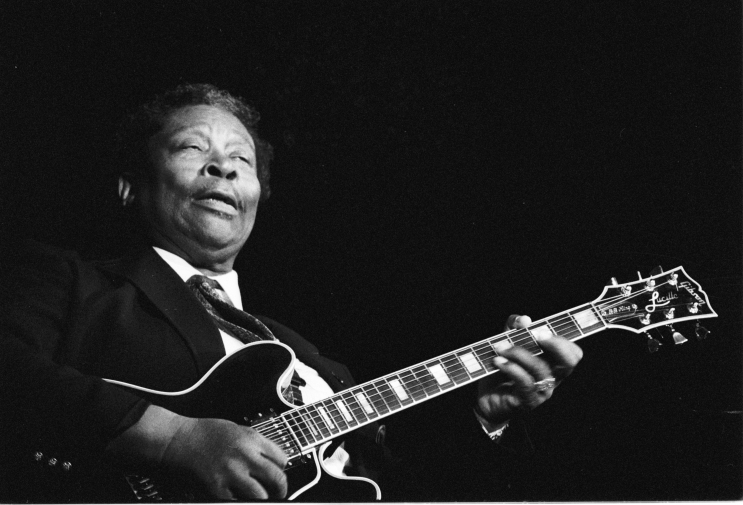
Riley Ben King (Itta Bena, 16 September 1925 – Las Vegas, 14 May 2015), better known as B.B. King, was an American blues guitarist and singer-songwriter. On 15 December 2006, B.B. King received the highest civilian honour, the Presidential Medal of Freedom. B.B. King is regarded as one of the greatest blues artists of all time. The music magazine Rolling Stone placed King third in a list of the hundred greatest guitarists. His best-known hit is his cover of "The Thrill Is Gone" from 1969.
King was born on a plantation and spent much of his youth working as a sharecropper alongside his mother and grandmother. Before he knew of his other talents, he would have been paid 35 cents per 45 kg of cotton. After his parents' divorce and the early death of his mother, he was raised by his grandmother. King attended the Elkhorn Baptist Church in Kilmichael. Early on, King was captivated by black musicians such as T-Bone Walker and Lonnie Johnson, and jazz artists like Charlie Christian and Django Reinhardt. He quickly developed his own musical skills in church by singing gospel. In 1943, B.B. King moved to Indianola, Mississippi. Three years later, he moved again to Memphis, Tennessee, where he refined his guitar techniques with the help of his cousin, country blues guitarist Bukka White. Here he regularly performed with Johnny Ace, Bobby Bland and Rosco Gordon, who after King's departure eventually called themselves the Beale Streeters. Eventually, King began performing his music live on Memphis radio station WDIA, a station that had just made a turn to playing only black music – which was very remarkable at the time. On air, King began using the name The Pepticon Boy, which later became Beale Street Blues Boy. That name was shortened to simply Blues Boy, which eventually became B.B.
In 1949, King's first two singles were released via Bullet Records from Nashville (Tennessee). His debut was Miss Martha King. In the same year, King began recording songs under contract with RPM Records. Many of his early recordings were produced by Sam Phillips, who would later found the legendary Sun Records.
King found his first success outside the blues market in 1969 with his remake of Roy Hawkins' melody, "The Thrill Is Gone", which became a hit in both the pop and R&B charts, a rare occurrence, especially at that time. King's success continued in the seventies with songs like "To Know You Is to Love You" and "I Like to Live the Love". From 1951 to 1985, King appeared no less than 74 times in the Billboard R&B charts.
B.B. King mainly played Gibson guitars and traditionally called them "Lucille". This originated in the winter of 1949. King was playing in Twist, a town in Arkansas, America. During his performance, two people started fighting and knocked over a barrel of burning kerosene that served as heating. This caused the building to catch fire. When everyone was outside, King realised he had left his guitar inside. He risked his life to retrieve his guitar. When King later heard that the fight was about a woman named "Lucille", he decided to name his guitar after her, to remind himself never to do something like that again.
On 14 May 2015, King died in his sleep. King had suffered from diabetes for years. This was seen, in combination with his age and dehydration symptoms, as the cause of death. On 25 May, it became known that the FBI had started an investigation into King's cause of death. According to King's daughters, he had been poisoned. No abnormalities were found during the autopsy.
Top 2000
In the 23rd edition of the Top 2000, B.B. King appears with 2 entries:
source: Wikipedia and NPO
photo: Roland Godefroy